 anypaypos








SEARCH WHAT YOU WANT
Search allProductNews
SEARCH
Choosing the best POS terminal for retail business is not simply about selecting a touchscreen device with attractive appearance. A professional retail checkout system needs to match the store’s operation process, software environment, customer experience requirements and future business development.
For different retail environments, the ideal POS terminal configuration can be completely different.
A small boutique store may need a compact touchscreen POS terminal that saves counter space. A supermarket may require stronger hardware integration with barcode scanners, customer displays, receipt printers and weighing equipment. A restaurant chain may focus more on fast order processing, stable network communication and easy employee operation.
Therefore, before purchasing retail POS hardware, businesses should first analyze their daily workflow.
Important factors usually include:
A reliable POS terminal should not only complete current transactions but also support future business growth.
Modern retailers increasingly prefer touchscreen POS terminals because they provide a more intuitive operating experience compared with traditional cash registers. Employees can quickly access product information, complete orders and manage transactions through a clear interface.
ANYPAYPOS provides various commercial POS hardware solutions designed for retail, restaurant and self-service applications, helping businesses create more efficient checkout environments.
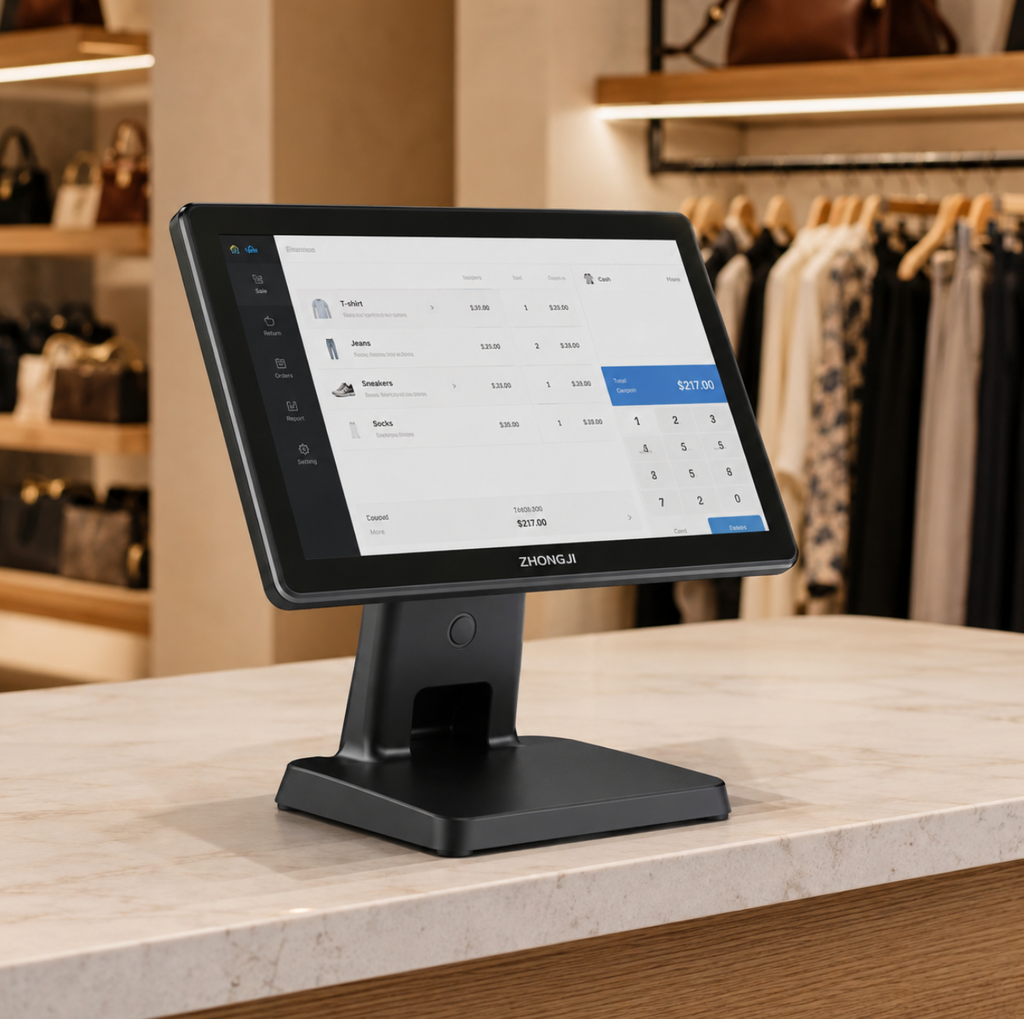
When choosing a retail POS terminal, hardware performance directly affects daily operation.
A checkout system operates continuously during business hours. Slow response speed, unstable connections or poor compatibility can interrupt transactions and reduce customer satisfaction.
Retail buyers should evaluate several hardware specifications:
The processor, memory and storage determine how smoothly the POS system operates.
Simple retail applications may require standard configurations, while larger stores running inventory management, customer loyalty programs or multiple software modules may need stronger hardware.
The touchscreen is the main interaction point between employees and the system.
A good retail POS terminal should provide:
For busy checkout counters, fast touch response can reduce unnecessary waiting time.
A POS terminal rarely works alone.
Retail systems often connect with:
Before mass deployment, businesses should test the complete hardware system instead of checking only the terminal itself.
Software compatibility is equally important.
A POS terminal should work smoothly with the existing retail software, including product management, inventory control, payment processing and reporting functions.
For distributors and system integrators, stable hardware compatibility is especially important because one successful configuration may be deployed across many stores.
Retail technology continues to develop. Businesses today may need more than simple payment processing.
Future retail systems may include:
Therefore, selecting a POS terminal with expansion capability can reduce future replacement costs.
For chain retailers, hardware standardization is also important.
Using the same POS terminal model across multiple stores can simplify:
OEM and distribution partners should also consider whether the manufacturer can provide customized solutions, including hardware configuration, branding and product packaging.
A reliable POS terminal supplier should support the complete process from product selection and sample testing to production and after-sales service.
The right POS hardware partner can help retailers create a stable foundation for long-term digital transformation.
Choosing the best POS terminal for retail business requires a complete evaluation of hardware performance, software compatibility, peripheral support and future expansion possibilities.
A professional retail POS terminal is not only a checkout machine but also an important part of store management and customer service.
By selecting suitable hardware and a reliable supplier, retailers can build a more efficient, stable and scalable checkout system.
Learn how POS buyers can evaluate hardware consistency, sample approval, production control and long-term supply before selecting a POS manufacturer.
View details
Compare traditional POS terminals and self-checkout kiosks to determine which checkout model fits different retail formats and transaction types.
View details
Learn about touchscreen POS terminal with practical guidance on hardware selection, integration and deployment for retail and hospitality projects from ANYPAYPOS.
View details
Compare restaurant POS terminals and self-ordering kiosks to plan ordering, checkout and customer flow for different restaurant formats.
View details